
Flourishing in Shared Spaces: What Co-working Leaders Can Learn from the Synchronous Life System
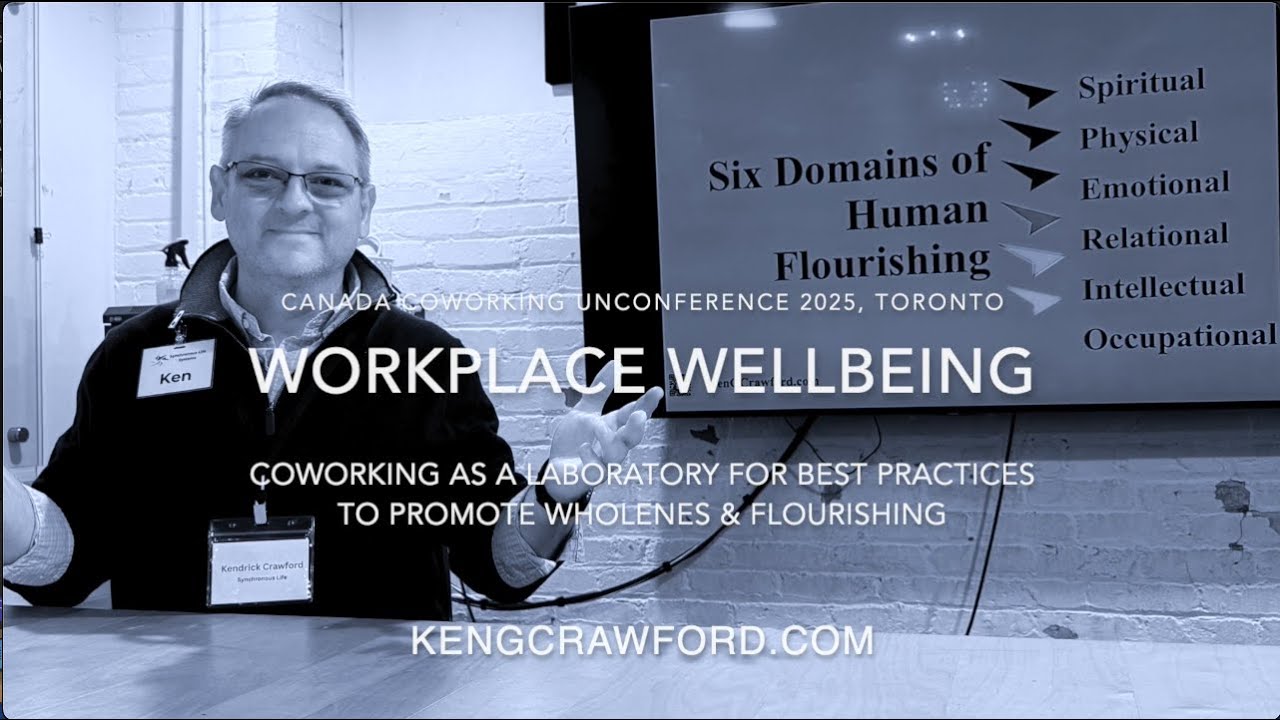
This fall, I had the chance to lead a session at the Coworking Canada Conference 2025 in Toronto on workplace well-being using the Synchronous Life System (SLS), the framework I've built over years of work as a pastor, consultant, and coach. You can watch the full session below, and I wanted to share some of the highlights here for anyone who couldn't make it to Toronto.
Why Finances Aren't a Domain of Flourishing
Most "wheel of life" frameworks include a finances category. SLS deliberately doesn't. Money isn't something we are or a way we experience the world; it's the medium of exchange that lets us trade energy from one domain to secure resources in another. We spend our intellectual and occupational energy to earn money, then use that money to take care of our bodies and our relationships. Especially in the U.S., people tend to overidentify with their financial picture as a stand-in for how their life is going. Pulling finances out of the model is a deliberate invitation to ask: what about the rest of me?
The Six Domains
SLS organizes human flourishing into six domains: Spiritual, Physical, Emotional, Relational, Intellectual, and Occupational. A couple of definitions are worth calling out because they tend to surprise people.
Spiritual doesn't require religion. It can show up as art, music, nature, or whatever core values give life its sense of meaning and ineffability.
Occupational is broader than a job. In its original sense, occupation means anything that occupies our time and energy in the world, including roles like parent, spouse, or adult child, anything we're committed to enough that we'll say no to other things to protect it.
A Practice You Can Start Today: The Daily Examen
One of the simplest tools from the session is a daily examen: three times a day, pause for about 30 seconds and score yourself 1 to 5 across each of the six domains. Morning, midday, and evening. Over time, this builds real self-awareness about which parts of your life are thriving and which ones are quietly being neglected, and what specific events or interactions move those scores up or down.
What This Means for Co-working Spaces
A good portion of the session was audience dialogue with co-working space owners and leaders in the room, and that's where the framework's value as a shared vocabulary really showed up. One leader described her space as leaning heavily emotional and relational, with members who treat shared couches (not desks) as the literal center of the space, and described becoming an informal listening point for member struggles, while also naming the toll that takes on her personally as a high-empathy introvert. Another, who works with an arts organization, described a strongly spiritual-forward culture among members, but cautioned that artists still need very practical occupational support around business development, since "I'm also a business" is a hard transition for many creatives to make.
These conversations point to a bigger idea: every co-working community has its own energetic center of gravity, and people are also drawn to different domains individually. The goal isn't to force everyone into the same mode of flourishing, but to build enough shared language and awareness that a community can recognize and honor those differences.
Simple Tools for Respecting Different Needs
We also talked through some lightweight, practical norms that space leaders can use immediately, including the "headphone rule": two earbuds in means deep focus, please don't interrupt; one earbud in means open to a quick chat; depending on the space, a stack of sticky notes can let people leave a note for someone who's heads-down rather than interrupting them outright. Small systems like this let a community make room for very different needs — introverts, extroverts, neurodivergent members, people having a hard day — without anyone having to explain themselves every time.
Coaching Over Advice-Giving
A theme that ran through the whole Q&A: when someone on your team or in your community names a struggle — procrastination, an inner critic, decision fatigue — our instinct is almost always to jump in with a solution. Coaching asks something different. Questions like "When have you been successful at something like this before?" or "What does that inner critic's voice actually sound like, and whose voice is it?" invite people to find their own insight rather than depending on someone else's answer. You don't have to be a professional coach to use this; even simple peer-coaching skills can give an entire team or community access to a kind of support that's normally reserved for paid one-on-one coaching.
An Invitation
I'm currently looking for five co-working spaces or small businesses — teams of any size, including volunteers and community animators — to pilot the SLS framework at no cost, in exchange for feedback that helps refine the tools. If that's you, or if you'd just like to talk through how this might apply to your space or team, I'd love to connect.
Visit kengcrawford.com to learn more, or schedule a time for us to talk.


